
Why Start a Vocational Training Institute Today
India’s growing demand for practical, job-oriented skills creates opportunities for organisations interested in vocational education. Employers need people with relevant technical knowledge and workplace skills, while learners increasingly explore training that can prepare them for specific careers. This makes understanding how to start a vocational training institute in India an important first step for aspiring entrepreneurs, coaching centre owners, NGOs and educational organisations. However, establishing a successful institute requires more than a suitable building. You need a clear business plan, appropriate facilities, qualified trainers, relevant courses and a reliable approach to quality management. This guide explains the key steps, including how to explore NCVE’s Authorised Training Provider programme.
Requirements to Start a Vocational Training Institute
Before opening a vocational training institute, prepare the organisation, premises, facilities and staff needed to deliver your proposed programmes. The exact requirements depend on your location, business structure, course selection and applicable regulations.
Legal Registration and Documentation
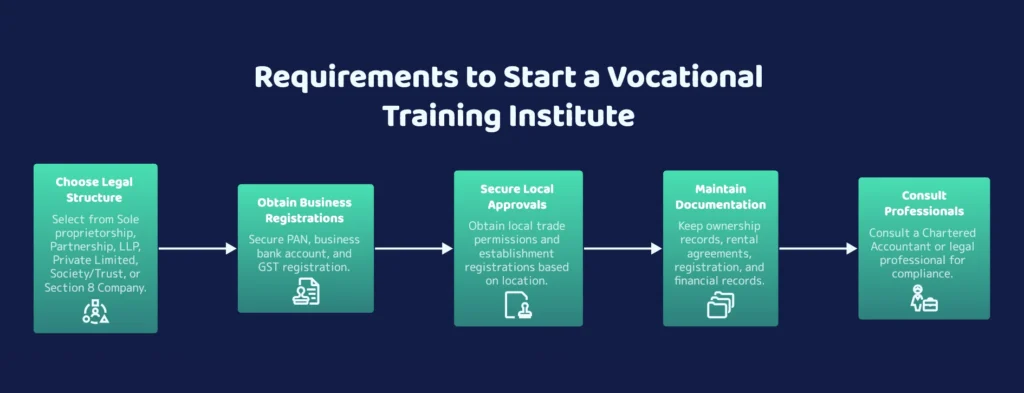
Start by choosing a suitable legal structure for your training business. Common options include:
- Sole proprietorship
- Partnership firm
- Limited Liability Partnership (LLP)
- Private Limited Company
- Society or Trust
- Section 8 Company
Each structure has different ownership, governance, liability and compliance considerations. A commercial training business may have different objectives from a non-profit educational organisation, so choose a structure that reflects your plans.
You may also need a Permanent Account Number (PAN), a business bank account and Goods and Services Tax (GST) registration where applicable. Depending on your location and activities, local trade permissions, establishment registrations or other approvals may also be relevant.
Keep documents relating to your premises, such as ownership records or a rental agreement, along with your organisation’s registration and financial records. Requirements vary, so consult a Chartered Accountant or legal professional before completing the registration process.
Infrastructure and Facilities
A vocational training centre needs an environment suitable for both theoretical instruction and practical learning. Plan classroom space, furniture, lighting, ventilation, internet access and administrative facilities. Courses involving hands-on activities may also require dedicated laboratories, workshops, tools and specialised equipment.
For example, a computer training programme may need suitable computers and licensed software, whereas automobile training requires appropriate workshop equipment and safety arrangements. Healthcare-related practical training may involve additional specialised facilities.
Consider accessibility, fire and electrical safety, equipment maintenance and secure storage when planning the premises. Do not assume that one minimum floor area or equipment list applies to every course. Confirm the relevant infrastructure requirements with NCVE for the programmes you intend to offer.
Trainer and Faculty Requirements
Qualified trainers are essential for delivering effective vocational education. Recruit people with relevant subject knowledge, technical qualifications and practical experience in their respective industries. Their ability to demonstrate procedures, explain concepts and guide learners through practical activities is equally important.
Prepare clear responsibilities for trainers, academic coordinators and administrative staff. Where applicable, check whether faculty members need additional training or professional development before delivering a programme.
It is also important to distinguish trainers from assessors. Trainers teach and support learners, while assessors evaluate whether learners have achieved the required competencies. Their roles and eligibility requirements may differ according to the qualification or programme. Confirm NCVE’s specific faculty requirements and any applicable trainer-to-learner ratio rather than relying on assumed figures.
Choosing the Right Vocational Courses and Sectors
Course selection should begin with an understanding of local employment opportunities and learner interests. Speak with nearby employers, review relevant job requirements and identify skills that are in demand in your area. Consider whether you can recruit suitable trainers and provide the facilities required to deliver each programme.
NCVE’s published course catalogue includes several sectors, such as:
- Advertising and Media: Digital Marketing, Photography and Graphic Design.
- Agriculture: Organic Farming, Vermicomposting and Horticulture.
- Allied Health Education: Patient Care Assistant and Medical Lab Assistant.
- Automobile: Two-Wheeler Repair and Automobile Servicing.
- Computer and IT: Computer Hardware and Networking, Web Design and Programming.
- Logistics and Supply Chain: Warehouse Management and Logistics and Supply Chain Management.
- Banking and Finance: Banking Operations and Financial Accounting.
Compare the investment needed for different courses. Digital marketing and some computer-based programmes may require fewer specialised physical resources than automobile servicing or electrical training, which can involve workshops, tools and safety equipment.
Review NCVE India’s sectors and courses before finalising your portfolio. Starting with a manageable number of programmes can make it easier to organise trainers, facilities, admissions and quality monitoring.
How to Become an NCVE Authorised Training Provider
NCVE offers an Authorised Training Provider (ATP) programme for organisations interested in delivering vocational training under its partnership arrangements. Applicants must complete the relevant application, accreditation and agreement requirements.
Eligibility and Application Process
If you want to become an NCVE Authorised Training Provider, begin by contacting NCVE to confirm whether your organisation and proposed programmes meet its current requirements. Do not assume that every legal structure or training business is automatically eligible.
Prepare relevant information about your organisation, including:
- Organisation details and registration documents, where applicable.
- Proposed courses and programmes.
- Premises and infrastructure information.
- Trainer and faculty profiles.
- Operational and financial details.
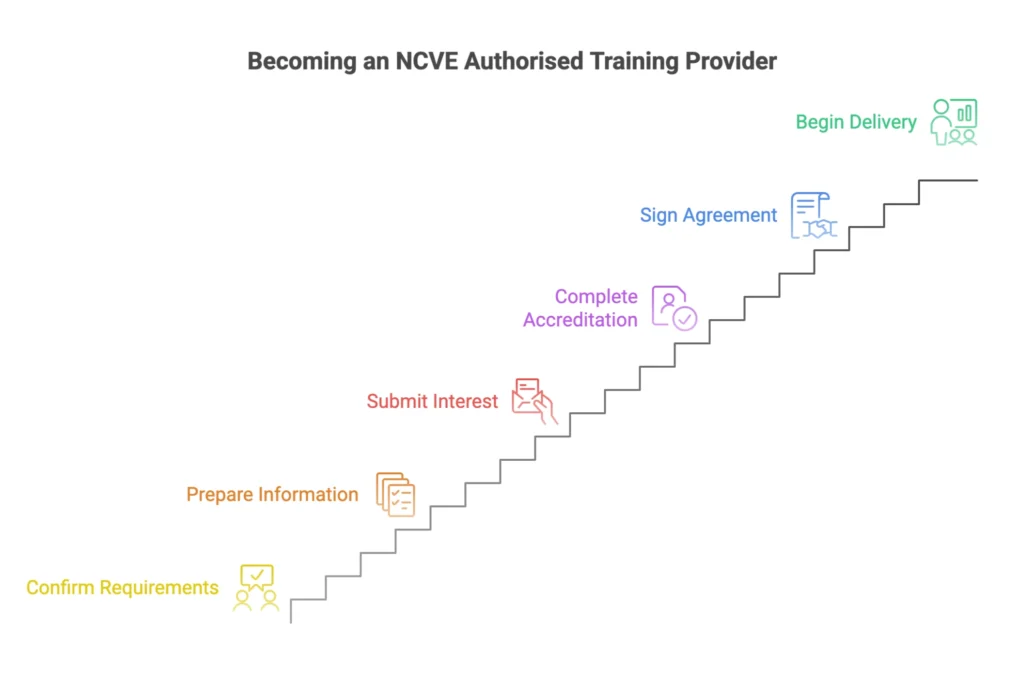
NCVE’s published application process describes the following steps:
- Submit an expression of interest: Share information about your organisation, programmes, facilities and proposed training activities.
- Complete the accreditation process: Participate in the eligibility review and assessment conducted by NCVE.
- Sign the partnership agreement: After accreditation is granted, review and sign the agreement setting out the partnership terms.
- Begin programme delivery: Proceed with training under the agreed NCVE arrangements.
Review the current application requirements before making financial commitments or announcing your centre’s accreditation status.
NCVE Accreditation Procedure
NCVE’s published accreditation guidelines describe a structured evaluation process designed to assess the quality and readiness of prospective training providers.
The main stages include:
- Initial enquiry and application: The applicant expresses interest and submits relevant programme, facility, faculty and operational information.
- Pre-assessment review: NCVE reviews the application against its eligibility criteria and accreditation standards. This may include regulatory compliance, financial stability and infrastructure.
- On-site assessment: NCVE may inspect facilities, observe classes, review documentation and interact with faculty, staff and learners.
- Evaluation and decision: The application is assessed against the relevant standards. Accreditation may be granted, denied or deferred for further action.
- Ongoing review: Accredited providers are expected to maintain standards, participate in periodic reviews and meet reporting requirements.
Prepare your documentation and facilities before the assessment. NCVE does not publish a fixed accreditation processing timeline in the procedure reviewed, so confirm the expected schedule directly rather than planning around an assumed approval date.
Benefits and Responsibilities of an NCVE Training Partner
Becoming an ATP may provide access to resources and support described by NCVE, including:
- Curriculum frameworks and instructional resources.
- Professional development opportunities.
- Industry-related networking and support.
- Assistance with employer connections and placement-related activities.
However, partnership also involves ongoing responsibilities. ATPs are expected to:
- Maintain appropriate facilities and qualified instructors.
- Follow NCVE’s programme and quality requirements.
- Maintain student admission, attendance and academic records.
- Provide accurate information about fees, courses and outcomes.
- Participate in quality reviews and submit required reports.
- Follow NCVE’s branding and marketing guidelines.
- Meet annual registration renewal requirements.
NCVE’s terms state that its ATP academic year runs from 1 June to 31 May, that ATP registrations must be renewed annually, and that fees paid to NCVE are non-refundable. Review the current ATP terms and conditions before applying. Partnership benefits should not be interpreted as guaranteed enrolment, employment or placement outcomes.
Understanding NCVE, NCVET and NSDC
The names NCVE, NCVET and NSDC are similar, but the organisations have different roles in India’s vocational education and skill development landscape.
| Organisation | What it is | Relevance to training institutes |
| NCVE – National Council for Vocational Education | Non-governmental educational organisation | Offers its own Authorised Training Provider programme and accreditation process. |
| NCVET – National Council for Vocational Education and Training | National regulatory body for vocational education and training | Regulates the vocational education and training ecosystem and recognises awarding bodies and assessment agencies. |
| NSDC – National Skill Development Corporation | Public-private partnership organisation under the Ministry of Skill Development and Entrepreneurship | Supports skill development initiatives and private-sector participation. |
NCVET was notified by the Government of India on 5 December 2018 and became fully operational on 1 August 2020. Its responsibilities include recognising and monitoring awarding bodies and assessment agencies.
NSDC was established on 31 July 2008 as a not-for-profit public limited company operating through a public-private partnership model. It supports private-sector participation and skill development initiatives.
NCVE’s ATP terms describe it as a non-governmental educational organisation. Its accreditation process is separate from NCVET recognition and NSDC partnerships. Therefore, do not describe NCVE as a government department, NCVET-recognised awarding body or NSDC partner without specific documentary confirmation.
For a clearer explanation of qualification levels and skill certification, read our guide to the National Skills Qualifications Framework (NSQF).
Investment and Financial Planning
Opening a vocational training institute involves initial setup expenses as well as recurring operating costs. The total investment depends on the location, premises, course portfolio, equipment and number of trainers required.
| Cost category | Expenses to consider |
| Premises | Rent, security deposit, renovation and utilities |
| Infrastructure | Furniture, computers, internet and classroom facilities |
| Practical equipment | Tools, machines, software and course materials |
| Trainers | Recruitment, salaries and professional development |
| Registration and compliance | Applicable professional and statutory costs |
| NCVE fees | Application, accreditation and renewal charges |
| Marketing | Website, advertising and local promotion |
| Software | Student management, attendance and accounting systems |
| Working capital | Rent, salaries and monthly operating expenses |
Separate one-time expenses, such as renovation and equipment purchases, from recurring costs such as rent, salaries, electricity and internet. This gives you a more realistic picture of the funds needed to establish and operate the centre.
Break-even planning is equally important. Estimate your monthly fixed expenses and the variable cost of training each learner. Then calculate how many paid enrolments are needed to cover those expenses. Potential revenue may come from course fees and eligible employer-sponsored or institutional training arrangements.
Government funding and financial support should only be included in your plan after checking the relevant scheme’s eligibility conditions. Since NCVE’s current ATP fee schedule and a universal institute investment estimate are not established in the public information reviewed, request the applicable charges directly from NCVE and obtain local cost quotations before preparing your budget.
Managing and Operating a Training Centre
Once your centre is established and the necessary partnership arrangements are completed, consistent management becomes essential. Create a clear admission and counselling process so prospective learners understand course content, duration, fees and entry requirements before enrolling.
Plan batches according to classroom capacity and trainer availability. Maintain accurate attendance, admission, fee, assessment and academic progress records. Make sure learners receive clear information about the organisation issuing their certificates and the status of the programmes they join.
Collect learner feedback, monitor teaching quality and provide appropriate academic support. Building relationships with local employers can also help you explore internships and employment opportunities. Regular internal reviews and organised documentation make it easier to monitor performance and meet ongoing accreditation responsibilities.
Common Challenges in Starting a Vocational Training Institute
New training providers may face several operational and financial challenges. Planning ahead can help reduce avoidable difficulties.
- Low student enrolment: Research local demand and build awareness before launching courses.
- Trainer shortages: Identify qualified trainers before finalising your programme portfolio.
- High equipment costs: Start with a manageable selection of courses and budget for essential resources.
- Documentation and compliance: Maintain organised records and seek professional guidance where required.
- Limited employer connections: Develop relationships with businesses and relevant industry representatives.
- Cash-flow difficulties: Maintain working capital and prepare for periods of slower enrolment.
A realistic business plan, suitable course selection and consistent quality management can help create a more sustainable training operation.
Frequently Asked Questions
1. How much does it cost to start a vocational training institute in India?
The cost depends on your location, premises, equipment, courses, trainers and operating expenses. A computer-based centre may need fewer specialised resources than an automobile workshop. Prepare a budget using local quotations and confirmed accreditation fees.
2. What are the requirements to become an NCVE Authorised Training Provider?
Applicants need to submit relevant organisational, programme, facility and faculty information and complete NCVE’s accreditation process. They must also meet the applicable partnership terms and ongoing quality requirements. Confirm current eligibility and documents directly with NCVE.
3. How long does NCVE accreditation take?
The duration depends on application review, assessment and the final accreditation decision. NCVE’s published procedure does not specify a fixed processing timeline. Contact NCVE to understand the expected schedule for your application.
4. Can an NGO or existing coaching centre apply?
An NGO or existing coaching centre can enquire about the ATP programme. However, eligibility depends on NCVE’s applicable requirements and the organisation’s proposed activities. Confirm whether your legal structure and facilities meet the current criteria before applying.
5. Do I need a registered company to start a training centre?
A private limited company is not the only possible organisational structure for a training business. Proprietorships, partnerships and other structures may be considered, depending on the purpose and applicable requirements. Seek professional guidance and confirm NCVE’s eligibility conditions.
For application guidance and current accreditation details, contact the NCVE India team.
Start Your Skill Development Centre with NCVE India
Starting a vocational training institute requires careful planning, suitable facilities, qualified trainers and courses that respond to local learning and employment needs. NCVE’s Authorised Training Provider programme offers an accreditation and partnership route for organisations interested in its training network. Review the process, confirm your eligibility and understand the applicable fees before proceeding.
Start your vocational training institute with NCVE India. Explore the Authorised Training Provider programme and take the first step towards building a skill development centre. Contact NCVE now.