
Why Understanding NSQF Matters
Completing a skills course and receiving a certificate is an important step towards building a career. But how do you know what that qualification represents? How can you compare it with another course or understand the skills and responsibilities it prepares you for?
The National Skills Qualification Framework (NSQF) helps answer these questions. It provides a common structure for organising qualifications according to learning outcomes, knowledge, skills and responsibility.
Whether you are a student, job seeker or working professional, understanding the NSQF framework can help you make more informed decisions about vocational education and skill development. This guide explains its levels, descriptors, certification process and how to check whether a qualification is officially NSQF-aligned.
What Is the National Skills Qualification Framework?
The National Skills Qualification Framework (NSQF) is an outcome-based and competency-based framework that organises qualifications according to different levels of knowledge, skills, aptitude and responsibility.
In simple terms, it describes what a learner is expected to know and be able to do after completing a qualification. Each level represents a different degree of complexity, independence and responsibility.
The framework supports the integration of vocational education, academic learning and workplace skills. It also recognises that learning can take place through formal education, non-formal training and informal experiences, provided the required learning outcomes are assessed.
India first introduced the NSQF on 27 December 2013. The framework was revised and notified on 6 June 2023, replacing the earlier version. The revision aimed to strengthen connections between vocational education, general education, training and skill development.
Importance of the NSQF Framework
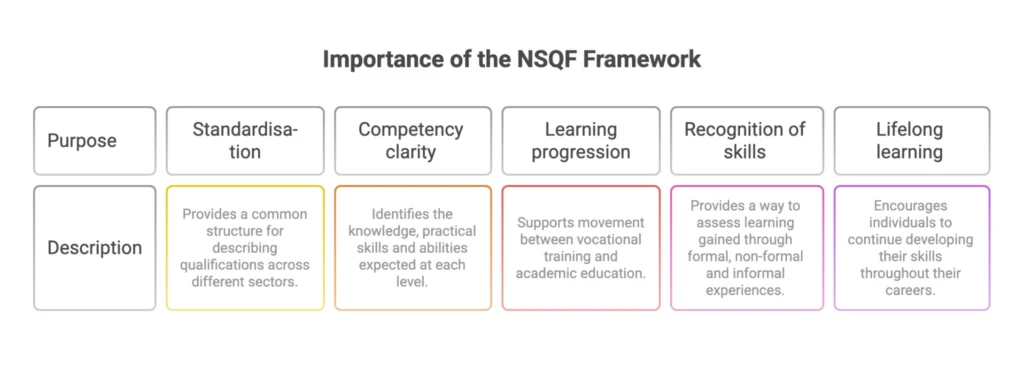
A common qualification framework makes it easier for learners, employers and training providers to understand different skill levels. Its key purposes include:
- Standardisation: It provides a common structure for describing qualifications across different sectors.
- Competency clarity: It identifies the knowledge, practical skills and abilities expected at each level.
- Learning progression: It supports movement between vocational training and academic education, subject to the applicable requirements.
- Recognition of skills: It provides a way to assess learning gained through formal, non-formal and informal experiences.
- Lifelong learning: It encourages individuals to continue developing their skills throughout their careers.
The NSQF also supports the integration of vocational and academic education. It works alongside the National Credit Framework (NCrF), but the two have different purposes. NSQF describes qualification levels and expected competencies, while NCrF provides a structure for assigning credits to learning. Under the NCrF, one credit corresponds to 30 notional learning hours, subject to the applicable assessment requirements.
Understanding NSQF Levels
The revised NSQF has eight numbered levels, from Level 1 to Level 8. Within this range, it specifies 13 levels: 1, 2, 2.5, 3, 3.5, 4, 4.5, 5, 5.5, 6, 6.5, 7 and 8.
These intermediate half-levels allow qualifications to be placed more precisely according to their learning outcomes. Each level represents a different degree of knowledge, technical skill, complexity, independence and responsibility.
The following table provides a simplified overview of the competency expectations described in the framework.
| NSQF level | General competency expectations |
| Level 1 | Elementary knowledge and basic, repetitive tasks performed under close supervision. |
| Level 2 | Basic working knowledge and the ability to perform structured tasks with limited responsibility. |
| Levels 2.5–3 | Knowledge of standard procedures, practical technical skills, problem identification and responsibility for the quality of one’s work. |
| Levels 3.5–4 | Specialised knowledge, advanced technical skills, problem-solving and the ability to handle complex tasks with greater independence. |
| Levels 4.5–5 | Multidisciplinary and specialised knowledge, complex decision-making, project management and responsibility for supervising work or managing an independent work unit. |
| Levels 5.5–6 | Advanced specialised knowledge, leadership, management of complex projects and accountability for larger teams or business activities. |
| Levels 6.5–7 | Highly specialised expertise, strategic thinking, innovation, leadership and responsibility for complex organisational activities. |
| Level 8 | Mastery of knowledge, advanced innovation, research, strategic leadership and responsibility for organisational growth and development. |
These descriptions are simplified summaries of the level descriptors. They are not automatic academic equivalences or fixed job classifications. The actual level of a qualification must be checked against its approved qualification record. A course’s duration or title alone does not establish its NSQF level.
NSQF Level Descriptors
NSQF level descriptors explain the learning outcomes and competencies expected at each level. They help qualification developers establish suitable learning requirements and provide a basis for assessing whether learners have achieved the required standards.
The revised framework describes each level through five domains:
- Professional theoretical knowledge: What the learner should know and understand about a subject, occupation or area of work.
- Professional and technical skills: The practical and technical abilities required to perform tasks and handle work-related challenges.
- Aptitude, mind-set and employability skills: Communication, digital and financial literacy, entrepreneurship, teamwork and other skills that support workplace readiness.
- Broad learning outcomes: The ability to apply knowledge and skills, solve problems and achieve the expected results.
- Level of responsibility: The degree of independence, accountability and responsibility expected when performing work.
Together, these five domains provide a broader picture of a learner’s competence. The framework considers not only theoretical understanding but also practical performance, employability skills and the ability to take responsibility.
How Does NSQF Certification Work?
NSQF certification is linked to an approved qualification and the assessment of its defined learning outcomes. The process involves specific requirements for the qualification, awarding body and assessment agency.
A general pathway involves the following stages:
- Choose an approved qualification: Identify a qualification that has been aligned with the NSQF and approved through the prescribed process.
- Complete the learning requirements: Undertake the required training, education or recognised learning pathway.
- Undergo assessment: Demonstrate the knowledge and practical competencies specified for the qualification. Assessment must be conducted through an NCVET-recognised assessment agency for the relevant approved qualification.
- Receive certification: After successful assessment, the NCVET-recognised awarding body issues the certificate in accordance with the applicable requirements.
- Check qualification details: Confirm the qualification title, level, awarding body and approval status in the National Qualifications Register (NQR).
An important distinction is that completing a course and receiving a certificate does not automatically make it an NSQF-aligned qualification. The qualification, awarding body and assessment arrangements must meet the applicable approval requirements.
To understand how one training organisation approaches assessment and certification, explore NCVE India’s [assessment and certification process] (internal link). This describes NCVE India’s own services and should not be interpreted as evidence that its programmes are NSQF-aligned.
Benefits of NSQF Certification
When a qualification is officially NSQF-aligned, the framework can offer several benefits to learners:
- Clearer qualification standards: Learners can understand the competencies and learning outcomes associated with a qualification.
- Better learning progression: Defined levels can support movement between vocational and academic learning pathways, subject to the applicable requirements.
- Recognition of prior learning: Existing skills and experience can be assessed through an appropriate process.
- Credit-based learning opportunities: The connection with NCrF can support the accumulation and transfer of credits, subject to assessment and applicable rules.
- Workforce relevance: Defined competencies can help employers understand the skills a qualification is intended to demonstrate.
However, NSQF alignment does not guarantee employment, a particular salary or acceptance by every employer. The value of a qualification depends on its relevance to the role, the employer’s requirements and any applicable eligibility conditions.
How to Check Whether a Qualification Is NSQF-Aligned
Before enrolling in a vocational programme, it is important to check whether the qualification is officially aligned with the NSQF. Do not rely only on promotional statements made by a training provider.
You can check the qualification through the National Qualifications Register (NQR), which maintains the official record of qualifications aligned to NSQF levels and approved through the prescribed process.
Follow these steps:
- Search for the qualification: Look for the qualification you intend to study in the register.
- Check the qualification title: Make sure the name matches the programme you are considering.
- Verify the qualification code: Check the unique code and other identifying details shown in the record.
- Confirm the NSQF level: Review the level assigned to that specific qualification.
- Check the awarding body: Confirm that the awarding body shown in the record matches the information provided by the training provider.
- Review its status: Check whether the qualification is current, expired or archived, along with its version and approval details.
If you cannot locate the qualification or the details do not match, ask the provider for official documentation before enrolling. The NQR helps verify the approved qualification and its details; it should not be treated as a database that independently verifies every individual learner’s certificate.
Difference Between NSQF, NCVET and NQR
NSQF, NCVET and NQR are closely connected, but they serve different purposes in India’s vocational education and training ecosystem.
| Term | What it is | Main role |
| NSQF | National Skills Qualification Framework | Organises qualifications according to levels of knowledge, skills, aptitude and responsibility. |
| NCVET | National Council for Vocational Education and Training | Acts as the national regulator for vocational education and training, including the recognition and regulation of awarding bodies and assessment agencies. |
| NQR | National Qualifications Register | Maintains a searchable record of qualifications aligned to NSQF levels and approved through the prescribed process. |
In simple terms, NSQF is the framework, NCVET is the regulator and NQR is the qualification register.
NCVET oversees the approval of qualifications under the NSQF and the recognition of relevant awarding bodies and assessment agencies. Approved qualifications are recorded in the NQR so that learners, employers and training providers can access their details.
Understanding these differences helps learners verify qualifications and make more informed decisions when choosing a training programme.
Recognition of Prior Learning (RPL)
Recognition of Prior Learning (RPL) is a process through which a person’s existing knowledge and skills are assessed and recognised. These competencies may have been gained through work experience, informal learning, traditional occupations or non-formal training.
For example, an electrician, mechanic, tailor or machine operator may have developed practical skills through years of work without completing a formal training programme. RPL provides a route for assessing those existing competencies against the requirements of a relevant qualification.
The process generally involves identifying the learner’s previous experience, assessing their skills against defined standards and determining whether they meet the required learning outcomes. Additional training may be needed where gaps are identified.
RPL is an important part of the NSQF because it recognises that valuable learning does not happen only in classrooms. It can also support lifelong learning and further progression, subject to the applicable assessment and eligibility requirements.
NCVE India and Vocational Skill Development
NCVE India focuses on vocational education and skill development through certificate and diploma programmes across multiple sectors. Its published course catalogue includes areas such as advertising and media, agriculture, allied health, automobile, computer and information technology, electrical and electronics, management, logistics, and banking and finance.
Its published catalogue lists certificate programmes generally lasting one to three months and diploma programmes ranging from six to twelve months. Examples include Digital Marketing, Photography, Organic Farming, Computer Hardware and Networking, Automobile Servicing, and Logistics and Supply Chain Management.
Learners can [explore NCVE India’s vocational courses] (internal link) to understand the available programme options and review the details before making a decision. Its assessment information also explains how the organisation approaches the evaluation of student learning and practical competencies.
It is important to distinguish NCVE India from NCVET. They are separate organisations. NCVE India is a non-governmental educational organisation, and its courses and certificates are not issued by a direct government body. Therefore, learners should not assume that an NCVE India programme is NSQF-aligned or NCVET-approved unless the exact qualification and its approval can be verified through the relevant official records.
For programme information or guidance, contact the NCVE India team
Frequently Asked Questions
What is NSQF in simple words?
NSQF is India’s framework for organising qualifications according to the knowledge, skills, aptitude and responsibility expected from learners. It helps people understand and compare the competency levels associated with different qualifications.
How many NSQF levels are there?
The revised NSQF has eight numbered levels, from Level 1 to Level 8, and specifies 13 levels in total. These include intermediate levels such as 2.5, 3.5, 4.5, 5.5, 6.5 and 7.
How can I check if a course is NSQF-aligned?
Search for the qualification in the National Qualifications Register (NQR). Check its title, qualification code, NSQF level, awarding body and current status. Compare these details with the information provided by the training organisation before enrolling.
What is the difference between NSQF and NCVET?
NSQF is the framework that organises qualifications into different levels. NCVET is the national regulatory body responsible for overseeing vocational education and training, including the approval of qualifications and recognition of relevant awarding bodies.
Is NSQF certification valid for jobs?
An NSQF-aligned qualification can help demonstrate defined competencies, but it does not guarantee employment. Whether it is accepted for a particular job depends on the employer’s requirements, the qualification and the eligibility conditions of the role.
Build Industry-Relevant Skills with NCVE India
Understanding NSQF helps you make informed decisions about vocational education and skill certification. Before choosing a programme, review its learning outcomes, assessment requirements and recognition details.
Explore NCVE India’s vocational courses to learn more about available programmes. You can also contact the NCVE India team for further information.
For training providers: Organisations interested in vocational training quality and accreditation can explore how to become an accredited training partner.