
Why Job-Ready Skills Matter Today
Employers across industries look for candidates who can apply their knowledge to real workplace tasks. Academic qualifications provide a foundation, but practical skills help learners understand how to perform specific roles and responsibilities.
For students completing their 10th or 12th, fresh graduates, job seekers and people considering a career change, vocational education offers an opportunity to develop industry-related skills. These programmes focus on practical learning and occupational knowledge, helping learners prepare for different career paths.
This guide explores some of the top vocational courses in India, the sectors they cover, possible career opportunities and factors to consider before enrolling. It also introduces NCVE India’s vocational programmes as an option for learners exploring skill development.
Importance of Vocational Education
Vocational education focuses on developing the knowledge and practical abilities required for a particular occupation or industry. Unlike programmes that are primarily academic, vocational courses place greater emphasis on applying skills through practical activities and job-related training.
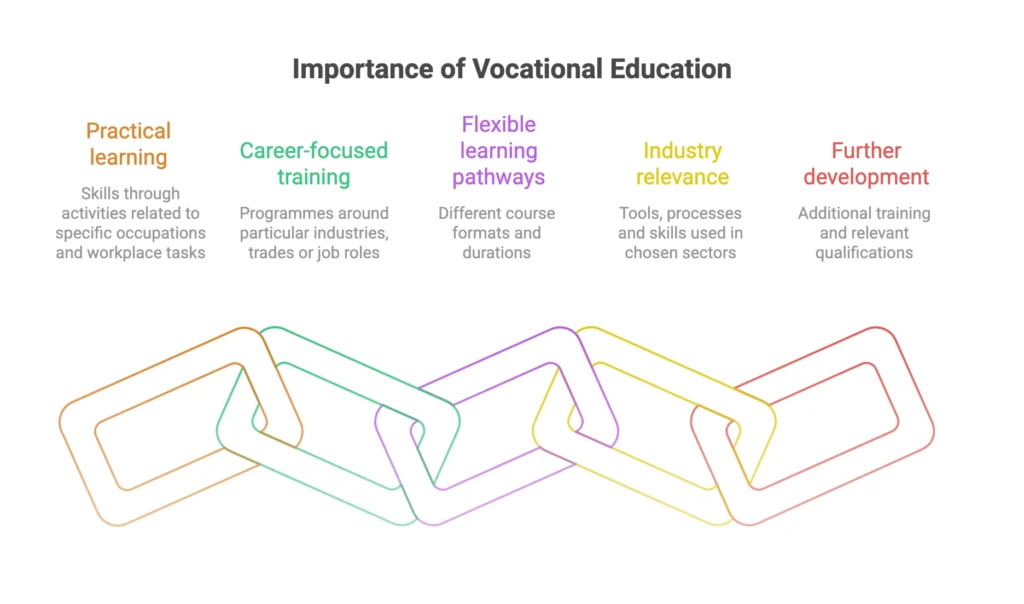
Here are some reasons why vocational education is an important part of career development:
- Practical learning: Learners develop skills through activities related to specific occupations and workplace tasks.
- Career-focused training: Programmes are designed around particular industries, trades or job roles.
- Flexible learning pathways: Different course formats and durations allow learners to explore options based on their educational background and career goals.
- Industry relevance: Vocational training can help learners understand the tools, processes and skills used in their chosen sectors.
- Opportunities for further development: Learners can build on their existing skills through additional training and relevant qualifications.
India’s National Education Policy (NEP) 2020 also highlights the importance of integrating vocational education into mainstream education. This reflects the wider focus on developing practical skills alongside academic learning.
Top Vocational Courses in India
Vocational courses are available across several industries, including information technology, healthcare, agriculture, engineering-related trades, finance and logistics. The right choice depends on your interests, educational background and the type of work you want to pursue.
The following sectors offer a range of vocational learning opportunities.
Information Technology
Information technology covers computers, software, networking and digital systems. As organisations depend on technology for daily operations, there are different technical and support roles within this sector.
Vocational training can help learners develop foundational knowledge of computer systems, applications and technical processes.
- Example courses: Computer Hardware and Networking, Web Design, Office Automation and Computer Programming.
- Eligibility: Requirements vary by programme and training provider.
- Typical course duration: Varies according to the course and qualification.
- Possible career roles: IT support assistant, computer technician, network support assistant and office automation operator.
Digital Marketing
Digital marketing involves promoting products, services and brands through online platforms. Businesses use search engines, social media, websites, email and digital advertising to connect with customers.
A vocational course in this field can introduce learners to online marketing tools, content creation, search engine optimisation and social media management.
- Example courses: Digital Marketing, Social Media Marketing, Content Writing and Advertising.
- Eligibility: Check the individual programme’s admission requirements.
- Typical course duration: Depends on the course structure and training provider.
- Possible career roles: Digital marketing assistant, social media executive, SEO assistant and content coordinator.
Healthcare
The healthcare sector includes hospitals, clinics, diagnostic centres and other care facilities. It requires professionals with different levels of education and training, including people who provide patient support and technical assistance.
Vocational programmes can introduce learners to specific healthcare support skills and related procedures.
- Example courses: Patient Care Assistant, Medical Lab Assistant, ECG Technician and Dental Assistant.
- Eligibility: Requirements depend on the course and the responsibilities associated with the role.
- Typical course duration: Varies by programme.
- Possible career roles: Patient care assistant, healthcare support worker and other relevant support positions, subject to the required qualifications.
Learners should check the applicable professional and regulatory requirements before enrolling in a healthcare programme. Completing a short course does not automatically qualify someone for every technical or clinical role.
Electrical and Electronics
Electrical and electronics training focuses on the installation, maintenance, troubleshooting and repair of electrical and electronic equipment. These skills are relevant to residential, commercial and industrial environments.
Learners interested in technical work can explore programmes that introduce electrical systems, equipment maintenance and basic automation.
- Example courses: Domestic Electrical Appliances Repair, Electronics Assembly Operator, Industrial Electrician and Refrigeration and Air Conditioning.
- Eligibility: Depends on the specific programme.
- Typical course duration: Varies according to the level and subject.
- Possible career roles: Electrical maintenance assistant, electronics technician and appliance repair technician.
Automobile Technology
Automobile technology covers vehicle maintenance, servicing, repair and diagnostics. The sector includes two-wheelers, passenger vehicles, commercial vehicles and newer automotive technologies.
Vocational training in this area can help learners understand vehicle components, repair procedures and workshop practices.
- Example courses: Automobile Mechanic, Two-Wheeler Repair, Automobile Servicing and Automobile Diagnostics.
- Eligibility: Check the entry requirements of the selected programme.
- Typical course duration: Depends on the course and training provider.
- Possible career roles: Automobile service assistant, vehicle maintenance technician and workshop support technician.
Agriculture
Agriculture and allied activities offer opportunities in cultivation, horticulture, food processing, animal husbandry and related businesses. Modern agricultural practices also involve better resource management and specialised techniques.
Vocational education can help learners develop practical knowledge of farming methods and agricultural activities.
- Example courses: Organic Farming, Horticulture, Poultry Farming, Dairy Farming and Mushroom Cultivation.
- Eligibility: Varies by programme.
- Typical course duration: Depends on the subject and course structure.
- Possible career roles: Farm supervisor, nursery assistant, agricultural support worker and dairy farm assistant.
Logistics and Supply Chain
Logistics and supply chain management involve the movement, storage and distribution of goods. Warehouses, manufacturers, retailers and e-commerce businesses depend on organised logistics operations.
Vocational courses in this sector can introduce learners to inventory control, warehouse operations, transportation and supply chain processes.
- Example courses: Warehouse Management, Inventory Management, Transportation Management and Import and Export Procedures.
- Eligibility: Check the requirements for each programme.
- Typical course duration: Varies by course.
- Possible career roles: Warehouse assistant, inventory assistant, dispatch coordinator and logistics operations assistant.
Banking and Finance
Banking and finance involve financial services, accounting, banking operations and the management of financial information. Learners interested in working with numbers and financial processes can explore vocational programmes in this sector.
These courses can provide foundational knowledge of financial operations and related administrative responsibilities.
- Example courses: Banking Operations, Financial Accounting, Digital Banking and Microfinance Operations.
- Eligibility: Depends on the selected programme.
- Typical course duration: Varies according to the course.
- Possible career roles: Accounts assistant, banking operations assistant and financial administration assistant.
Quick Comparison: Vocational Courses After 10th vs After 12th
Students can explore vocational education after completing either their 10th or 12th standard. However, admission requirements differ between programmes and training providers.
The table below provides examples of course areas to explore. It does not represent universal eligibility criteria.
| Course area | Examples | Possible career direction |
| Electrical and electronics | Appliance repair, electronics assembly | Electrical and maintenance support |
| Automobile technology | Two-wheeler repair, automobile servicing | Vehicle servicing and repair |
| Agriculture | Organic farming, poultry farming | Agricultural and allied activities |
| Logistics | Warehouse management, inventory management | Warehouse and logistics operations |
| Healthcare | Patient care, medical lab assistance | Healthcare support |
| Information technology | Hardware and networking, web design | IT and technical support |
| Digital marketing | Digital marketing, social media marketing | Online marketing and content |
| Banking and finance | Banking operations, financial accounting | Banking and financial administration |
Before enrolling, learners should check the course’s minimum educational qualification, age requirements, practical training arrangements and assessment process.
Vocational Courses Offered by NCVE India
NCVE India offers certificate and diploma programmes across multiple vocational sectors. Its published course catalogue includes options in information technology, advertising and media, allied health, agriculture, automobile technology, electrical and electronics, management, logistics and supply chain, banking and finance, among other fields.
Some examples from its course catalogue include:
| Sector | Example courses |
| Computer and IT | Computer Hardware and Networking, Web Design, Office Automation |
| Advertising and Media | Digital Marketing, Social Media Marketing, Content Writing |
| Allied Health | Patient Care Assistant, Medical Lab Assistant, ECG Technician |
| Agriculture and Allied | Organic Farming, Poultry Farming, Mushroom Cultivation |
| Automobile | Automobile Mechanic, Two-Wheeler Repair, Car Detailing |
| Electrical and Electronics | Domestic Electrical Appliances Repair, PLC Programming, CCTV Installation |
| Logistics and Supply Chain | Warehouse Management, Inventory Management, Transportation Management |
| Banking and Finance | Banking Operations, Digital Banking, Microfinance Operations |
According to the published catalogue, certificate programmes are listed with durations of one to three months, while diploma programmes are listed with durations of six to twelve months. The actual course details and availability should be confirmed with NCVE India before enrolment.
How Assessment and Certification Work
Assessment is an important part of vocational education because it helps evaluate what learners have understood and whether they can demonstrate the relevant competencies.
NCVE India’s published assessment information describes methods such as performance-based assessments and standardised assessments. These approaches are intended to evaluate learners’ knowledge, practical abilities and competencies.
Learners should review the assessment arrangements, course requirements and certification details before joining a programme. They should also check the organisation issuing the certificate and understand the scope of the qualification.
Explore NCVE India’s Sectors and Courses to compare the available programmes.
Choosing the Right Vocational Course
Selecting a vocational course is an important step towards building a career. Rather than choosing a programme only because it is popular, consider whether it matches your interests, abilities and long-term plans.
Keep these factors in mind:
1. Identify your interests: Think about the type of work you enjoy. Technical, creative, administrative and healthcare-related fields require different skills.
2. Research career opportunities: Explore the roles available in your preferred sector and check the qualifications employers expect.
3. Compare course content: Review the syllabus, practical components and skills covered in the programme.
4. Check the duration and cost: Consider the time required to complete the course and compare the total fees, including any additional charges.
5. Confirm eligibility: Check the admission requirements directly with the training provider before applying.
6. Understand certification: Find out who issues the certificate, how assessment is conducted and whether the qualification meets your intended career or further-study requirements.
For students who have completed their 10th standard, it is also useful to consider whether the selected course allows them to continue their education. Career changers can look for programmes that build on their existing knowledge and work experience.
Certificate vs Diploma Courses
Certificate and diploma programmes are two common options in vocational education. They differ in their scope, duration and learning objectives. However, the exact structure depends on the institution and the qualification being offered.
| Factor | Certificate course | Diploma course |
| Focus | Usually concentrates on a specific skill or subject | May cover a broader area of study |
| Duration | Depends on the programme | Depends on the programme |
| Learning approach | Often focuses on particular competencies | May include a wider range of theoretical and practical topics |
| Suitable for | Learners seeking focused training or additional skills | Learners looking for more extensive subject knowledge |
For example, NCVE India’s published catalogue lists its certificate programmes at one to three months and its diploma programmes at six to twelve months. These durations apply to the programmes listed in that catalogue and should not be treated as standard durations for every vocational qualification in India.
Before choosing either option, compare the course syllabus, entry requirements, assessment process and certification details.
Future Career Opportunities Through Vocational Education
Vocational education can help learners prepare for different occupational pathways. Depending on the course, practical experience and employer requirements, learners may explore opportunities in sectors such as IT, healthcare support, agriculture, automobile services, electrical maintenance, logistics and finance.
Career progression depends on several factors, including individual performance, additional qualifications, industry experience and the availability of opportunities.
With relevant experience and further skill development, learners may work towards:
- Technical and specialist roles: Developing expertise in a particular trade or technical area.
- Supervisory positions: Taking on responsibilities for coordinating teams or daily operations.
- Self-employment: Using acquired skills to explore independent service-based or small-business opportunities.
- Further education: Pursuing additional certificates, diplomas or other qualifications where the admission requirements are met.
Vocational education can provide a foundation for career development, but completing a course does not guarantee employment or a particular salary. Learners should continue developing their skills and gain relevant practical experience.
Build Career-Ready Skills with NCVE India
Choosing the right vocational course can be a useful step towards developing practical knowledge and exploring career opportunities. From information technology and digital marketing to healthcare support, agriculture, automobile technology and logistics, learners have different fields to consider.
The important thing is to select a programme that matches your interests, educational background and career objectives. Review the course details, understand the assessment process and check the certification requirements before making a decision.
Explore NCVE India’s vocational courses to learn more about the available certificate and diploma programmes. If you need further information about a course or its requirements, contact the NCVE India team for guidance.
Training providers interested in delivering vocational programmes can also learn more about becoming an NCVE Authorised Training Provider. To find out more about NCVE’s training programmes, contact us today.